
Alameda County Plan Check Guide For Retail Food Facilities
Revised January 2021
Alameda County Environmental Health Department
1131 Harbor Bay Parkway, Alameda, CA 94502
(510) 567-6700
health.alamedacountyca.gov/acehd
Table of Contents
- Introduction
- Plan Review Process
- Environmental Health Plan Review Process Flow Chart
- Plan Review Fees
- Plan Review Submission Requirements
- Construction
- Equipment Requirements
- Warewashing and Glass Washing Machines
- Sneeze Guards
- Refuse Disposal Facilities (Trash Enclosure)
- Toilet Facilities
- Designated Employee Areas/Lockers
- Plumbing
- Grease Traps and Interceptors
- Dipper Well
- Cooking Equipment
- Mechanical Exhaust Ventilation
Introduction:
This Plan Review Guide is intended to provide information about the requirements for food facility plans in Alameda County. The recommendations herein are designed to give general guidance about the environmental health requirements for approval of construction or remodeling plans for food facilities. This guide references the California Retail Food Code, (CRFC also known as Cal Code), but is not itself a law or regulation. It is also based on the recommendations of the California Conference of Environmental Health Director’s Plan Check Guide for Retail Food Facilities, 2019.
Other agencies including local building, fire, zoning and sanitation districts may have jurisdiction over various aspects of a project. Please consult with them or any other relevant agency for requirements or permits.
Note that examples and drawings contained in this document are for illustrative purposes only. They may not be to scale and should not be copied and submitted as approved plans.
For more information visit our website at health.alamedacountyca.gov/acehd or call (510) 567-6700.
Plan Review Process:
The California Retail Food Code, Section 114380(a) states:
(a) A person proposing to build or remodel a food facility shall submit complete, easily readable plans drawn to scale, and specifications to the enforcement agency for review, and shall receive plan approval before starting any new construction or remodeling of any facility for use as a retail food facility.
(b) Plans and specifications may also be required by the enforcement agency if the agency determines that they are necessary to assure compliance with the requirements of this part, including but not limited to a menu change or change in the facility’s method of operation.
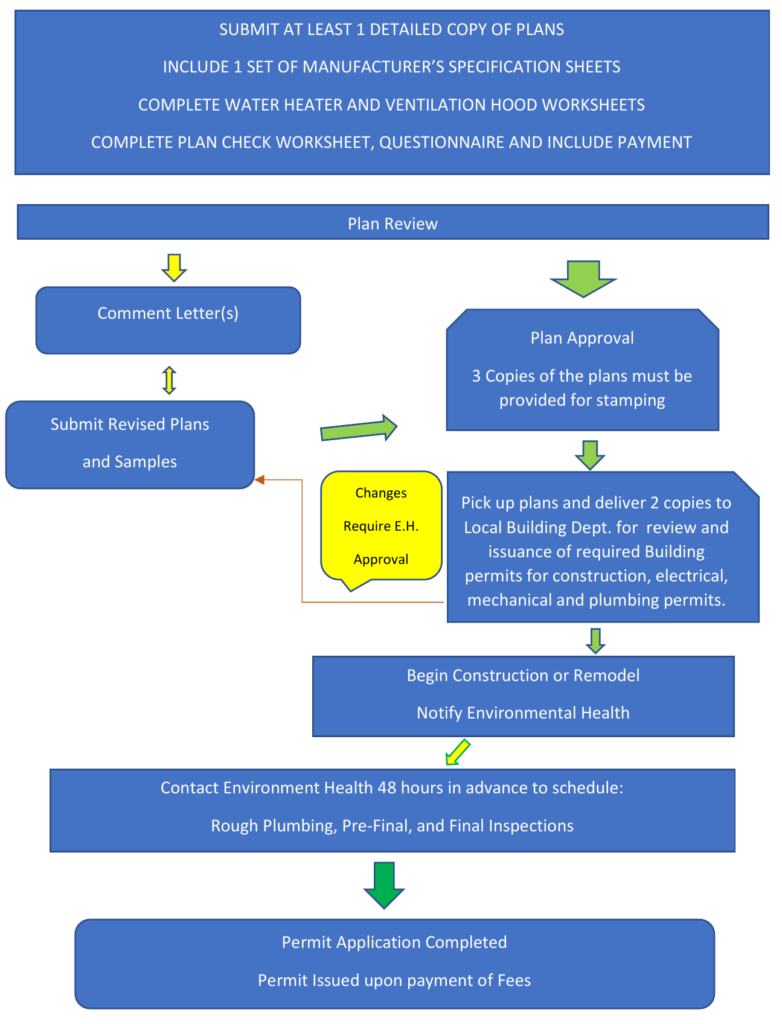
Environmental Health Plan Review Process Flow Chart
Plan Review Fees:
Fees vary depending on the type and size of facility. The current fee schedule can be accessed on our website.
In addition to the facility plan review fee there is an extra fee for each Ventilation Hood System.
Normal Plan Review provides 1st response time is within 20 working days.
Expedited Plan Review provides 1st response time within 7 working days.
Additional site visits or review time may result in additional hourly charges.
Approved plans are valid for 6 months. A re-stamping fee may be charged for expired plans.
Plan Review Submission Requirements:
Initially 1 physical set of plans, drawn to 1/4 -inch per foot scale, must be submitted along with Manufacturer’s Specification Sheets for all proposed equipment. (Upon plan approval, three (3) full sets must be provided for stamping).
The plans must include:
Proposed Menu
Vicinity Plan- Show nearest cross streets.
Site plan- Indicate building locations, work area(s), trash enclosure.
Building Plan- Identify kitchen, food storage rooms, ware washing area, mop sink/janitorial closet, walk-ins, restrooms, bars, employee break area, dining areas, ancillary areas, hallways and display areas, and adjacent businesses. Identify all doors, windows, pass through windows and air curtains.
Equipment Plan- Show the location of all cooking equipment, sinks, refrigerators, freezers, work tables, counters, dish machines, storage shelves, finfish and shellfish tanks. Also show employee lockers, chemical storage cabinet, any countertop equipment and sneeze guards. Include a cross referenced and numbered equipment list.
Finish Schedule- Indicate floor, cove base, wall and ceiling finishes for each room. Provide a reflected ceiling plan and show lighting locations.
Plumbing Plan- Show hot and cold-water lines, drain lines, floor sinks, floor drains, water heater, grease trap and/or interceptor. Indicate which sewer connection will be in-direct. Complete the Water Heater Worksheet.
Elevations- Provide an elevation view of counter and cabinet areas showing construction and finishes, legs and or coving. Include scale drawings of any sneeze guards.
Ventilation Hood Plan- Provide mechanical and architectural drawings to show the hood, exhaust ducting, insulation materials, location of equipment on roof, filter details, grease cup location and make up air return registers. Include all fan specifications and listing information. Complete our Ventilation Hood Worksheet and draw cooking equipment as it will be located under the hood with proper clearances.
Complete the Plan Check Questionnaire and Plan Check Worksheet for submittal with payment.
Include Manufacturer’s Specification Sheets for all equipment.
Construction Requirements:
Enclosure
Each PERMANENT FOOD FACILITY shall be fully enclosed in a building consisting of permanent floors, walls and an overhead structure that meet the minimum standards of this part. (CRFC-114266)
Exterior Doors and Windows:
All Exterior doors shall be well fitted and self-closing to effectively prevent the entrance of Vermin including but not limited to rodents and insects. (CRFC-114259) This includes doors to outdoor dining areas.
Delivery Doors must be self-closing and equipped with an air curtain that activates whenever the door is opened.
An air curtain installed inside the building shall produce a downward and outward air flow not less than three (3) inches thick at the nozzle with an air velocity of not less than 1600 FPM (feet per minute) across the entire opening at a point three (3) feet above the floor. (State of California, Food and Drug Circular 80-7)
An air curtain installed outside the building shall produce air at the same velocity (1600 FPM) directed straight down across the entire door opening. The air curtain shall tum on automatically when the door is opened. (State of California, Food and Drug Circular 80-7)
Large cargo type doors shall not open directly into a food preparation area. Cargo type doors that open into any food warehouse of a food facility may only be open during deliveries. (CRFC 114266(a))
Windows that open must be covered by 16 mesh per inch or smaller screens.
Folding, sliding or accordion doors are not allowed without fixed screening.
Pass Through Windows:
Pass-through window service openings shall be limited to 216 square inches each. Pass-through windows of up to 432 square inches are approved if equipped with an air curtain device. It is important to measure only the actual opening to determine compliance and not measure the entire window. (CRFC 114259.2)
Each opening shall be provided with a solid or screened window, equipped with a self-closing device, or an automatic switch-activated air curtain. Screening, if used, shall be at least 16-mesh-per-inch.
The minimum distance between pass-through window openings shall not be less than eighteen (18) inches.
The counter surface of the pass-through window must be smooth, and easily cleanable. The counter surface should be and free of channels and crevices. (CRFC 114259.2)
Floors:
Floors in food establishments (except in sales and dining areas) shall be durable, smooth, non-absorbent and easily cleanable. Floor surfaces in all areas where food is prepared, packaged, or stored, where any utensil is washed, where refuse or garbage is stored, where janitorial facilities are located, in all toilets and hand washing areas, shall be an approved type. (CRFC-114268)
Customer cooking areas must have food preparation flooring and cove bases.
Examples of approved floors include:
- Commercial Sheet Vinyl- Homogenous construction with .080-inch thick wear layer and heat welded seams
- Quarry Tile
- Poured Epoxy at least ¼-inch thick. Submit Manufacturer’s Specification Sheet and sample for approval.
Floor surfaces shall be coved at the juncture of the floor and wall with a 3/8-inch minimum radius coving and shall extend up the wall and toe-kicks of floormounted counters/cabinets at least 4 inches, except in areas where food is stored only in unopened bottles, cans, cartons, sacks, or other original shipping containers. (CRFC-114268(b))
Walk-in Coolers located in a food preparation area must have a 3/8-inch radius continuous cove base on the exterior and interior. An integral cove base is not required inside the walk-in cooler interior if the cooler contains only unopened food containers.
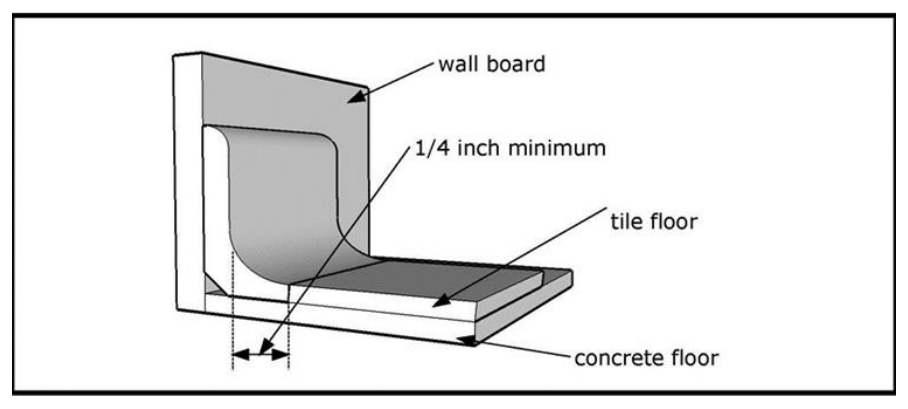
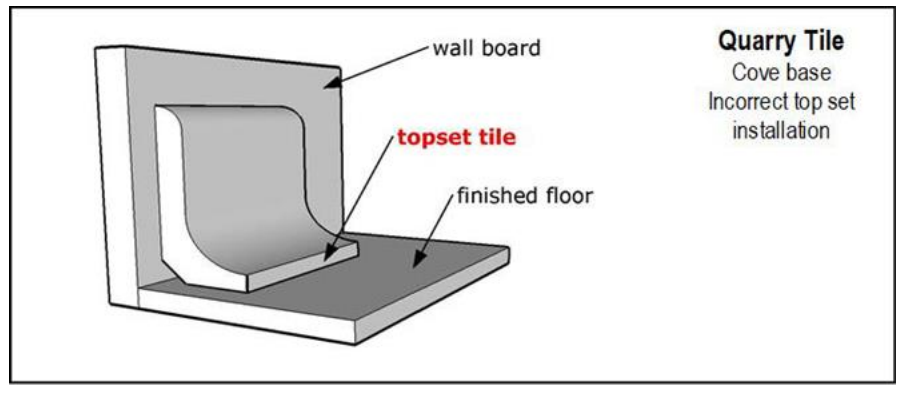
Top-set rubber or tile base is not approved except in customer areas.
Upon new construction or extensive remodeling, floor drains shall be installed in floors that are water-flushed for cleaning and in areas where pressure spray methods for cleaning equipment are used. Floor surfaces in areas pursuant to this subdivision shall be sloped to the floor drains. (CRFC- 114269)
Walls and Ceilings:
Walls and ceilings of all rooms shall be durable, smooth, non-absorbent and easily cleanable. (CRFC- 114271) except:
- (a) Bar areas where alcoholic beverages are sold directly to the consumers. (Note: wall areas adjacent to sinks and areas where food is prepared must
be smooth and cleanable.) - (b) Areas where food is stored in unopened bottles, cans, cartons, sacks or other original shipping containers.
- (c) Dining and sales areas.
- (d) Offices.
- (e) Dressing rooms or areas and locker rooms.
Restrooms must have a wainscot of FRP, ceramic tile or equivalent to a height of 48 inches above the finished floor.
Kitchen and warewashing areas must have FRP, ceramic tile or stainless steel to 8 feet minimum or full height.
Janitorial areas must have FRP or equivalent to a height of 48 inches above finished floor.
Acoustic ceiling tiles must be the washable type. They must be installed not less than six (6) feet above the floor. A sample may be required for review.
Cooklines must have cleanable and fire-resistant materials as required.
Exposed brick, concrete block, rough concrete, rough plaster or textured gypsum board is not acceptable in food preparation, warewashing or open food storage areas.
The inside and outside of casework and cabinetry must be smooth and easily cleanable (laminate or equivalent).
Conduits:
Conduits of all types shall be installed within the wall wherever possible. If exposed conduits must be mounted ½-inch from the wall and at least 6-inches above the floor to allow cleaning access. Multiple lines must be wrapped or encased for cleaning purposes.
The area surrounding a conduit penetration shall be sealed.
No horizontal conduits are allowed within a ventilation hood.
Storage:
Adequate and suitable space shall be provided for the storage of food. (CRFC 114047) Approximately twenty-five percent (25%) of the food preparation area or at least 96 linear feet of approved shelving (excluding refrigeration). Linear feet of storage space must have a minimum depth of at least 18 inches. Each permitted facility must have its own dedicated dry food storage area.
All shelving shall be durable, smooth, and easily cleanable. Free standing and wall mounted shelving must be ANSI approved. The lowest shelf shall be at least six (6) inches above the floor, with a clear unobstructed area below.
Food and food related products must be stored in approved and accessible locations. Storage areas must not be near cleaning equipment, supplies and poisonous substances (CRFC 114254.2).
Food shall not be stored in any of the following ways: (a) In locker rooms. (b) In toilet rooms. (c) In dressing rooms. (d) In refuse rooms. (e) In mechanical rooms. (f) Under sewer lines that are not shielded to intercept potential drips. (g) Under leaking water lines, including leaking automatic fire sprinkler heads, or under lines on which water has condensed. (h) Under open stairwells. (i) Under other sources of contamination (CRFC 114049).
Adequate and suitable space shall be provided for the separate storage of clean and soiled linens. Linens shall be stored in clean, nonabsorbent receptacles or clean, washable laundry bags. (CRFC 114185.4)
A room, area or cabinet separated from any food preparation or storage area, or ware washing or storage area, shall be provided for the storage of cleaning equipment and supplies. (CRFC 114281)
Lighting:
In every room and area in which any food is prepared, manufactured, processed or packaged, or in which utensils are cleaned, sufficient natural or artificial lighting shall be provided to produce the following light intensity:
10-footcandles:
- (a) At least 30 inches above the floor in Walk-in refrigeration units and dry storage areas.
- (b) At a working surface on which alcoholic beverages are prepared or where utensils are used in the preparation or service of alcoholic beverages.
- (c) Inside equipment such as reach-in or under-the-counter refrigerators.
20-footcandles:
- (a) At a surface where food is provided for consumer self-service, or where fresh produce or prepackaged foods are sold or offered for consumption,
- (b) In server stations where food is prepared,
- (c) at a distance of 30 inches above the floor in areas used for handwashing, ware washing, and equipment and utensil storage, and in toilet rooms.
- (d) In all areas and rooms during periods of cleaning.
50-footcandles:
- (a) where a food employee is working with food or working with utensils or equipment such as knives, slicers, grinders, or saws where employee safety is a factor,
Light bulbs shall be shielded, coated, or otherwise shatter-resistant in areas where there is non-prepackaged ready-to-eat food, clean equipment, utensils, and linens, or unwrapped single-use articles. (CRFC 114252.1(a))
Shielded, coated, or otherwise shatter-proof bulbs are not required in areas used only for storing prepackaged food in unopened packages, if the integrity of the packages cannot be affected by broken glass falling into them and the packages are capable of being cleaned of debris from broken bulbs before the packages are opened. (CRFC 114252.1(b))
Infrared and other heat lamps must be protected against breakage by a shield surrounding and extending beyond the bulb so that only the face of the bulb is exposed, or by using approved coated shatter-resistant bulbs. (CRFC 114252.1(c))
Water:
An adequate, protected, pressurized, potable supply of hot water and cold water shall be provided. The water supply shall be from a water system approved by the health officer or the local enforcement agency. Hot water must be supplied at a minimum temperature of 120°F as measured from the faucet. (CRFC 114192(a)) Obtain approval from Land and Water Protection Division if water is supplied from a well or if there is an onsite wastewater treatment system.
Each food facility should be provided with its own dedicated commercial water heater. Hot water generation and distribution systems shall be sufficient to meet the peak hot water demands throughout the food facility. Where fixtures are located more than sixty feet (60’) from the water heater, a recirculation pump must be installed. (CRFC 114192, 114195)
In sizing the water heater, the peak hourly demands for all sinks, ware washing machines, etc., are added together to determine the minimum required Recovery Rate in Gallons per Hour. The type of facility is then factored into the calculation. See the Water Heater Worksheet for specific calculations. Indicate proposed the water heater’s capacity (gallons), BTU’s/hr. or kW’s, and the recovery rate.
If installing a Tankless Water Heater, the Manufacturer’s Specification Sheet must be provided for review. (Include the flow rate in Gallons per Minute at a 50 Degree F. Temperature Rise)
CCDEH Guidelines for Sizing Water Heaters may be downloaded.
Point of use water heater units can be installed at hand sinks or trash enclosures. Hoses for conveying potable water must be constructed of non-toxic materials, must not be used for any other purpose, and must be clearly labeled as to its use. (CRFC 114192(b))
The potable water supply must be protected with a backflow or back-siphoning protection devices when required by applicable plumbing codes. Exposed piping of a non-potable water system shall be identified so that it is readily distinguishable from piping that carries potable water (CRFC 114192(c))
Handwashing facilities shall be equipped to provide warm water under pressure for a minimum of 15 seconds through a mixing valve or combination faucet. If the temperature of water provided to a handwashing sink is not readily adjustable at the faucet, the temperature of the water shall be at least 100°F, but not greater than 108°F. (CRFC 114192.J(d))
The water source and system shall be of sufficient capacity to meet the peak demands of the food facility. (CRFC 114195(a))
Equipment Requirements:
All new and replacement equipment shall meet or be equivalent to applicable sanitation standards and designed for commercial use.
All new and used equipment and utensils shall be certified or classified for sanitation by an American National Standards Institute (ANSI) accredited certification program (e.g. NSF, ETL Sanitation, UL EPH, UL Sanitation, CSA Sanitation). Equipment design, construction and installation are subject to approval by the enforcement agency. (CRFC 114130)
Note: Look for ANSI accredited companies when selecting equipment:

*An ANSI accredited third party evaluator may be acceptable upon review.
(https://anabpd.ansi.org/Accreditation/product-certification/DirectoryListingAccredited?prgID=1)
All utensils, display cases, windows, counters, shelves, tables, refrigeration units, sinks, dishwashing machines and other equipment or utensils used in the preparation, sale, service and display of food shall be made of nontoxic, corrosion resistant, nonabsorbent materials and shall be constructed, installed and maintained to be easily cleaned. (CRFC 114130)
Equipment shall be installed to facilitate cleaning under and around the equipment, and of all the adjacent surfaces. Equipment that is fixed because it is not easily movable shall be spaced to allow access for cleaning along the sides, behind and above the equipment, or shall be sealed to adjoining equipment or walls. Floor-mounted equipment that is not easily movable shall be sealed to the floor or elevated on legs that provide at least a sixinch clearance between the floor and the equipment. (CRFC 114130.4, 114169)
Walk-in coolers and freezers, exhaust hoods, and some large bakery equipment must be flashed to the walls and ceiling with an approved washable material to close off any area that is otherwise not easily accessible for cleaning.
Self-contained refrigeration units must be placed on casters.
All cracks and crevices at construction joints of counters, cabinets, bars, and similar fixtures shall be sealed with a caulking type sealant. All finishes shall be smooth and washable.
Refrigeration:
All reach-in and walk-in refrigeration and freezer units shall be adequate in capacity and usage to meet the needs of the proposed operation and shall:
(CRFC 114153, 114130)
- (a) Have shelving that is nonabsorbent, corrosion resistant, easily cleanable and shall meet or be equivalent to applicable ANSI standards. Wood is not acceptable. (CRFC 114130.1, 114130.4)
- (b) Be provided with an accurate, readily visible thermometer. (CRFC 114157)
- (c) Drain condensate and other liquid waste in a sanitary manner to a floor sink or other approved receptor via an in-direct connection. Condensate from reach-in refrigerators and freezers may be drained to a properly installed and functioning evaporator. (CRFC 114193)
- (d) Open into an approved area of the food facility. (CRFC 114049, 114266)
Walk-in refrigeration and storage freezer units shall also:
- (a) Be designed to be closeable, sealed to the floor, or be constructed integral with the floor. Coved bases shall be provided at the intersection of interior floors and walls. (CRFC 114259, 114268(b))
- (b) Be flashed or sealed to walls and/or ceiling as needed to prevent rodent and vermin harborage or inaccessible areas. (CRFC 114259, 114169)
- (c) Have floor drains and floor sinks located outside units, when they are required. (CRFC 114193, 114269, 113715)
Ice Machines:
All ice machines shall be located within the building in an easily cleanable, well-ventilated area, and shall be drained in-directly through an air gap to a floor sink. (CRFC 14193)
Liquid waste drain lines shall not pass through an ice machine or ice storage bin. (CRFC 114171)
Sinks:
When a sink is installed next to a wall, the integral metal backsplash shall be sealed to the wall. (CRFC 114169)
Hot and cold water under pressure shall be provided through a mixing valve to each compartment of the sinks.
Ware washing Sinks:
Where multi-service facility utensils (i.e., pots, pans, etc.) are used, a minimum three (3) compartment stainless steel sink with dual integral stainless steel drainboards shall be provided. (CRFC 114099 (a))
The sink must be capable of accommodating the largest utensil to be washed and integral drainboards shall be required on both sides. (CRFC 114099(b))
Food Preparation Sink:
Food facilities needing a separate sink for food preparation such as, but not limited to, thawing, washing, or soaking shall have a food preparation sink that drains by means of an indirect connection into a floor sink. The food preparation sink shall have a minimum dimension of 18Lx18Wx12D inches with an integral drainboard at least 18Lx18W inches. (CRFC114193(a) & 114163(b)(2), 114163))
Handwashing Sinks:
Handwashing sinks shall be provided in each work area where food and/or utensils are handled. The handwashing facility shall be separated from any other sink or food contact surfaces by a metal splashguard with a height of at least 6 inches that extends from the back edge of the bowl to the front edge of the bowl, with the corners of the splashguard barrier to be rounded. No splashguard is required if the distance between the handwashing sink and the ware washing sink drainboards is 24 inches or more. (CRFC 113953)
Hand wash sinks must be provided in or adjacent to toilet rooms. (CRFC 113953(a))
Wall mounted liquid hand soap and single-use paper towels shall be provided in dispensers at the handwashing sinks. (CRFC 113953.2) Hand dryers are only permissible in the restrooms. Wrist handle faucets for handwashing sinks are recommended.
Handwashing sinks shall have such water provided from a combination faucet, or water from a premixing faucet which supplies warm water for a minimum of fifteen (15) seconds while both hands are free for washing. (CRFC 113953)
Janitorial Sink:
Permanent food facilities shall be equipped with at least one of the following to be used exclusively for general cleaning purposes and for the disposal of mop bucket waste and other liquid waste:
- A curbed cleaning facility
- A janitorial sink (CRFC 114279(a))
- *Note: Floor mounted installation is recommended.
The sink shall be located so as not to contaminate any food preparation areas, food storage areas, utensils or equipment. (CRFC 114281)
The mixing valve faucet shall be equipped with a backflow prevention device. (CRFC 114190)
Janitorial sinks must be equipped with broom and mop hangers over the sink (CRFC 114282), and a chemical storage shelf and/or cabinet.
Warewashing and Glass Washing Machines:
An area should be provided for scraping utensils and equipment, as circumstances require. An overhead pre-rinse sprayer with scupper tray, sink or garbage disposal will satisfy this requirement. (CRFC 114099.1(a)(b))
Spray type warewashing and glass washing machines, which are designed for a hot water bactericidal rinse, shall be capable of achieving a utensil surface temperature of 160°F as measured by an irreversible registering temperature indicator. High temperature stand-up warewashing machines normally require an approved Type II exhaust hood. (CRFC l 14099.7(a)).
*Depending on the jurisdiction, any stand up warewashing machine may require Type II exhaust hood and/or a vapor removal device.
The mechanical application of sanitizing chemicals by pressure spraying methods using one of the following solutions:
- (a) Contact with a solution of 50 ppm available chlorine for at least 30 seconds.
- (b) Contact with a solution of 25 ppm available iodine for at least one minute. (CRFC l 114099.7(b), 114149.2(b))
- (c) Contact with any chemical sanitizer that meets the requirements of Section 180.940 of the Code of Federal Regulations.
Spray type warewashing and glass washing machines that are designed for a chemical bactericidal rinse shall be capable of operating in accordance with its approved applicable sanitation listing. The manufacturer’s data plate shall be affixed to the machine, easily accessible and readable (CRFC 114101(a), 114101.1)
Warewashing, glass washing and undercounter dish machines must have two (2) integral stainless steel drainboards, one for soiled utensils and one for clean utensils. The drainboards shall be sloped and drained to an approved waste receptor. (CRFC l 14103). One drainboard can be shared with the 3-compartment sink if space is limited.
Drainboards or dish tables shall be large enough to adequately store all utensils above the floor, at all times, or additional approved shelving, racks or dish tables shall be provided in the warewashing area for this purpose. (CRFC 114178, 114103)
When a dish table is installed next to a wall, the integral metal backsplash shall be sealed to the wall. (CRFC 114103(d), 114169(a)(3))
Sneeze Guards:
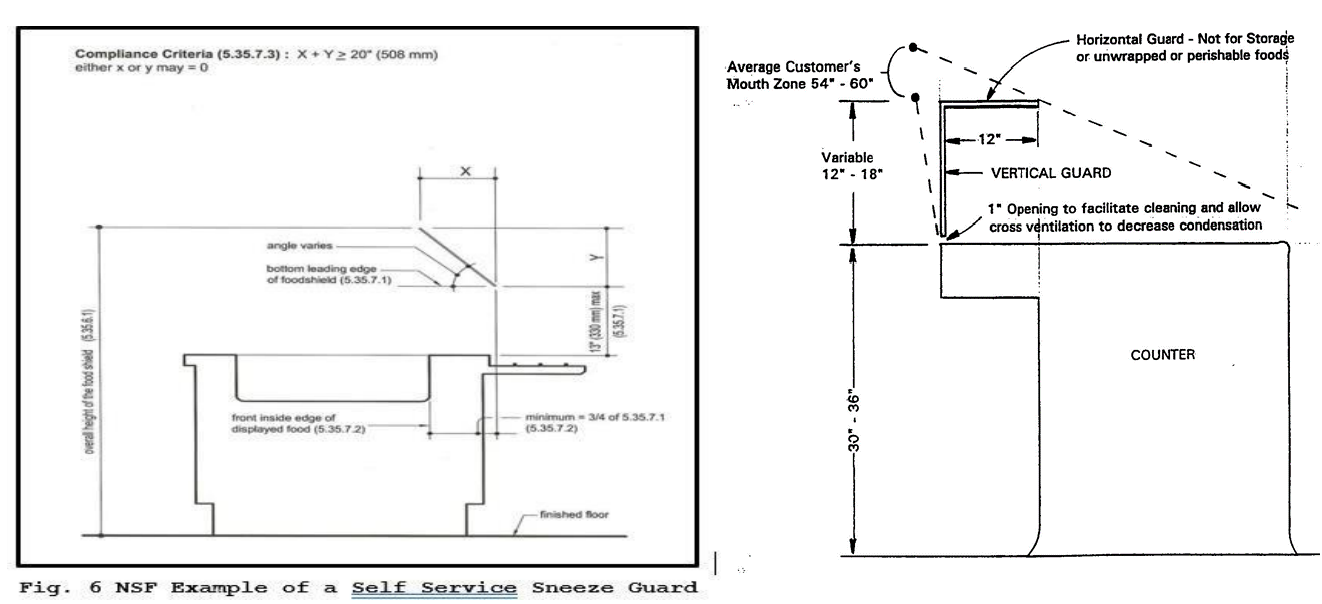
Except for produce displays in retail grocery stores, unpackaged foods shall be shielded to intercept a direct line between the customer’s mouth and the food being displayed or shall be dispensed from approved self-service containers. Provide detailed drawings (scale 1 inch = 1 ft.) of all proposed sneeze guards, including a detail showing the 54”-60” nose/mouth zone to the top of the display. See above sample drawing.
Sneeze guards shall be a minimum of 60” high from the finished floor. The sneeze guard must continue around the side of the display far enough to interrupt the path from a customer’s nose/mouth zone standing to the side of the display.
Food display, utensils, food preparation surfaces, and food preparation equipment which are located adjacent to customer accessible areas, must be protected by approved sneeze guards. See above sample drawing.
Approved cleanable flooring (3-foot perimeter from the edge of the counter), with integral cove base (if floor mounted), walls, and ceilings are required in self-service open food areas.
Refuse Disposal Facilities (Trash Enclosure):
Each facility shall be provided with any facilities and equipment necessary to store or dispose of all waste material. Waste receptacles shall be provided for use by consumers and in each area of the facility or premises where refuse is generated.
Garbage and waste grease shall be disposed into durable, cleanable, leak-proof, rodent proof containers with close-fitting lids. An area designated for refuse, recyclables, or returnables shall be located in a designated area that it is separate from food, equipment, utensils, linens, and single-service and single-use articles. (CRFC 114244, 114245 to 114245.7, 114257, 114175)
A designated area shall be provided for the storage and washing of these containers. Suitable cleaning implements and supplies such as high-pressure pumps, hot water, steam, and detergent shall be provided as necessary for effective cleaning of receptacles and waste handling units for refuse, recyclables, and returnables. (CRFC 114245.6 & 114245.7)
If located within the facility, refuse disposal, recyclable storage and returnables storage rooms and areas shall meet the requirements for floors, base, walls, ceilings, and vermin exclusion as specified. (CRFC 114245.3 &114268)
Receptacles and waste handling units for refuse, recyclables, and returnables shall not be located so as to create a public health hazard, nuisance or interfere with the cleaning of adjacent space. (CRFC 114245(b))
Floors that are water-flushed for cleaning and in areas where pressure spray methods for cleaning equipment are used must be sloped 1:50 to the floor drain(s) discharging to the sanitary sewer. Where washdown facilities are provided, liquid waste shall be disposed to floor drains going to an approved sewage disposal system. (CRFC 114245.4, 114268, 114269, 114279)
The room or enclosure shall be well ventilated. (CRFC 114149(a))
Hot and cold running water through a mixing valve protected with a backflow protection device shall be provided and located so that the room or enclosure can be cleaned. (CRFC 114245.7)
An out-door storage area or enclosure used for refuse, recyclables, and returnables should be constructed of nonabsorbent material such as sealed concrete or asphalt and shall be easily cleanable, durable, and sloped to a drain. (CRFC 114245.4).
Receptacles and waste handling units for refuse and recyclables must be installed so that accumulation of debris and insect and rodent attraction and harborage are minimized, and effective cleaning is facilitated around and, if the unit is not installed flush with the base pad, under the unit. (CRFC 114245.5)
Waste oil can be accumulated inside the facility in a 35 gallon or less approved container on casters, in an approved large built in tank system, and/or outdoors with secondary containment with lid if not placed inside of a trash enclosure with roof.
Consult with the local sanitary district regarding grease interceptor and/or sand oil water separator system requirements.
Toilet Facilities:
In each permanent food facility, there shall be employee toilet facilities. The requirements on the number of toilets and handicapped facilities shall be in accordance with local building and plumbing ordinances. (CRFC 114250 & 114276(e))
The toilet facilities shall be situated so that patrons do not pass through food preparation, food storage or utensil washing areas. (CRFC 114250 & 114276)
The floors, base, walls and ceilings shall have surfaces that are smooth, durable, nonabsorbent and easily cleanable. Toilet rooms shall be provided with at least 20-foot candles of light. (CRFC 114252(b)(3), 114268(a) & 114271)
Handwashing facilities shall be provided within or adjacent to toilet rooms and shall be equipped to provide warm (100°F) water under pressure for a minimum of 15 seconds through a mixing valve or combination faucet. The number of handwashing facilities required shall be in accordance with local building and plumbing codes. Handwashing cleanser and singleuse sanitary towels in dispensers or hot air blowers shall be provided at or adjacent to handwashing facilities. (CRFC 113953, 113953.2, 114276)
Toilet tissue shall be provided in a permanently installed dispenser at each toilet. (CRFC 114250)
Toilet rooms shall be separated from other portions of the food establishment by well-fitted, self-closing doors that prevent passage of flies, dust or odors. (CRFC 114276(c))
Public toilet facilities shall be provided in each permanent food facility when there is onsite consumption of food or when the food facility has more than 20,000 square feet of floor space. A food facility with more than 20,000 square feet of floor space shall provide at least one separate toilet facility for men and one separate toilet facility for women. (CRFC 114276)
Toilet rooms shall be vented to the outside air by means of an open-able screened window, an airshaft or a light switch-activated exhaust fan, consistent with the requirements of local building codes. (CRFC 114149(b))
Food facilities located within amusement parks, stadiums, arenas, food courts, fairgrounds, and similar premises shall not be required to provide toilet facilities for employee use within each food facility if approved toilet facilities are located within 200 feet in travel distance of each food facility and are readily available for use by employees. (CRFC 114250.1)
Designated Employee Areas/Lockers:
Areas designated for employees to eat or drink (break rooms) shall be located so that food, equipment, linens, and single-use articles are protected from contamination. (CRFC 114256(a))
Employee lockers or other suitable facilities shall be located in a designated room or area where contamination of food, equipment, utensils, linens, and single-use articles cannot occur. [CRFC 114256.1(b)).
Lockers or other suitable facilities, such as closets, shall be provided and used for the orderly storage of employee clothing and other possessions. (CRFC 114256.1(a)) Employee lockers shall be wall mounted a minimum of 6” above the floor with no legs. Provide coat hooks if not accommodated by the existing lockers.
Dressing rooms or dressing areas shall be provided and used by employees if the employees regularly change their clothes in the facility. (CRFC 114256.1(b))
Restricted food service facilities and nonpermanent food facilities are not required to provide lockers, etc., but no person may store clothing or other personal effects in any area used for the storage or preparation of food. (CRFC 114256.1(c))
Plumbing:
All plumbing fixtures shall comply with applicable local plumbing ordinances and be installed in accordance with local plumbing regulations.
All condensate and similar liquid wastes, e.g., espresso machines, soda and beer dispensers, and some coffee units, walk-in refrigerators/freezers, food preparation sinks, steam tables, ice machines, shall be drained by means of in-direct waste pipes into a floor sink.
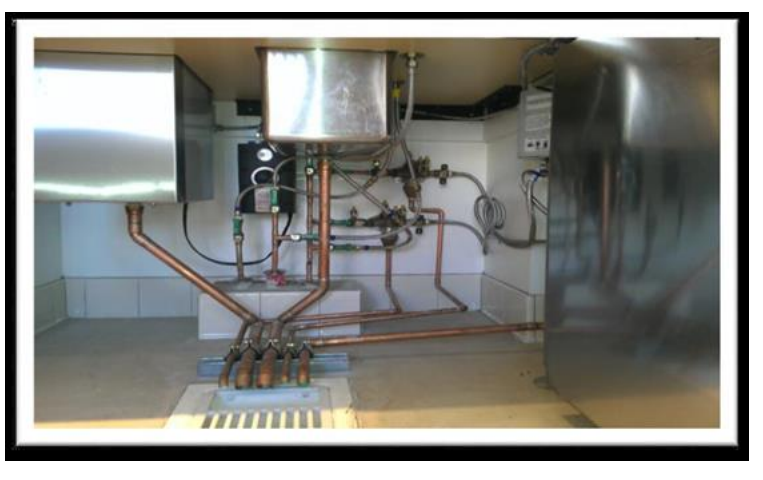
Ware washing sinks and ware washing machines shall drain indirectly to floor sinks unless the local building department requires a direct connection. When plumbed direct, connections to sewer must meet plumbing code requirements.
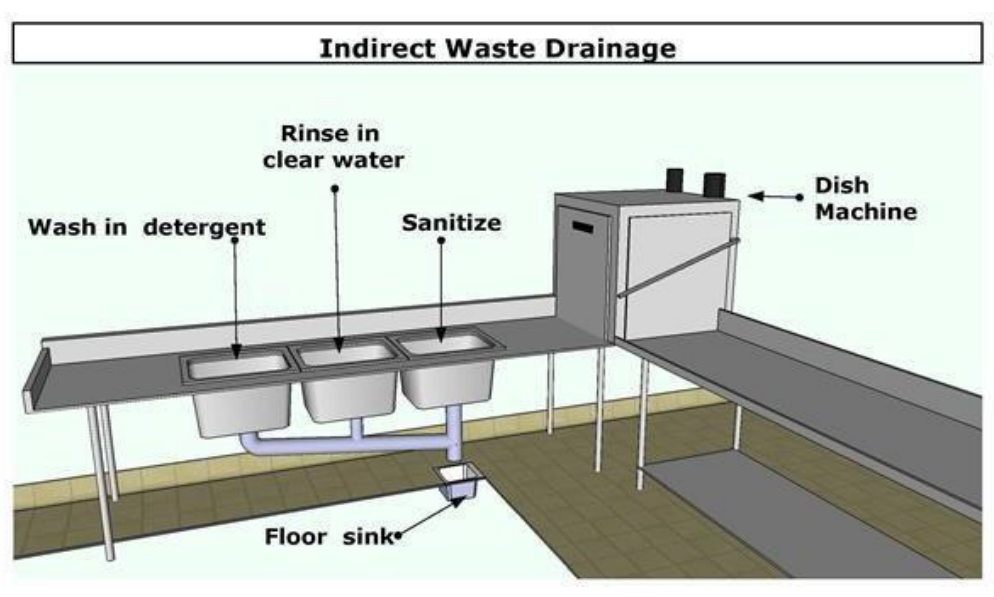
Floor sinks must be located to be easily visible for inspection and easily accessible for cleaning. The Floor Sink must be installed flush with the finished floor and half exposed under cabinets or low standing equipment. An air gap must exist between the rim of the floor sink and the drain pipe.
Grease Traps and Interceptors:
Check with the Local Sanitary District or Building Department regarding the size and location of the grease removal device.
Grease traps and grease interceptors shall be easily accessible for servicing. (CRFC 114201)
The grease removal device shall be flush-mounted in the floor. If the grease removal device cannot be flush-mounted, it shall be located at least six inches from the wall for cleaning access or completely sealed to the wall and floor.
Flush-mounted devices may be installed in vaults provided the vault is constructed to be watertight and as not to create a nuisance.
Each grease removal device must be clearly identified on plans.
All grease removal must be handled by a registered transporter (licensed grease hauler).
Dipper Well:
A cold running water dipper well shall be provided if scoops or other reusable serving utensils are stored in water. The dipper well shall be drained by means of an indirect connection. (CRFC 114119(d),114193(a))
A heated dipper well (keeping water above 135 F.) can also be installed (CRFC 114119(f)).
Cooking Equipment:
All equipment shall be installed on castors or six (6) inch high round metal legs.
Cookline equipment should be on castors to provide cleaning access.
Gas cooking equipment must have quick disconnect gas lines and seismic restraints.
All Cooking equipment must fit under the hood with a 6-inch overhang.
Mechanical Exhaust Ventilation:
All areas of a food facility shall have sufficient ventilation to facilitate proper food storage and to provide a reasonable condition of comfort for each employee, consistent with the job performed by the employee. (CRFC 114149(a))
Toilet rooms shall be vented to the outside air by means an openable, screened window, an airshaft, or a light-switch activated exhaust fan, consistent with the requirements of local building codes. (CRFC 114149(b))
Mechanical exhaust ventilation shall be provided over all cooking equipment (inclusive of customers’ dining tabletop cooking units) as required to effectively remove cooking odors, steam, heat, grease, smoke, and vapors. Mechanical ventilation shall be installed and maintained in accordance with the California Mechanical Code. Makeup air shall be provided at the rate exhausted. (CRFC 114149.1(a)) The makeup air registers should be located to prevent a shortcircuiting of the air being supplied for the exhaust system.
Type I exhaust hoods shall be required over all cooking equipment that may produce grease-laden vapors such as ranges, griddles, fryers, char-broilers, wok ranges, tandoor ovens, rotisseries, tilting-skillets, conveyor pizza ovens, etc.
Cooking equipment that uses solid fuel shall be provided with a separate exhaust system.
Type II exhaust hoods shall be required over all equipment that may produce steam, heat and non-grease-laden vapors, such as high temp dishwashing machines, gas rice cookers, ovens that do not require Type I hoods, rethermalizers, gas-fired coffee roasters, steam cookers, pasta cookers, hot pot cookers, etc.
Note: some local jurisdictions require a Type II hood or vapor recovery system for low temperature dish machines.
Certain types of cooking equipment (e.g. induction cookers, convection ovens, hot plates) may be considered for exemption from hood requirements. See Cooking Equipment Exhaust Ventilation Exemption Guide. Complete Application for Exemption from Mechanical Ventilation.
Ventilation Hood Systems:
- (a) Every hood shall be installed to provide for thorough cleaning of all interior and exterior surfaces, including, but not limited to, the hood, filters, piping, lights, troughs, hangers, flanges, and exhaust ducts. (CRFC 114149.2)
- (b) Exhaust ventilation systems in food preparation and ware washing areas shall be designed to prevent grease or condensation from draining or dripping onto food, equipment, utensils, single use articles, and linens. (CRFC 114149.2)
Heating, Ventilating, Air Conditioning System Vents:
- (a) Heating, ventilating, and air conditioning systems shall be designed and installed so that make-up air intake and exhaust vents do not cause contamination of food, food-contact surfaces, equipment, or utensils and do not create air currents that cause difficulty in maintaining the required temperatures of potentially hazardous foods. (CRFC 114149.3)
- (b) Filters or other grease extracting equipment shall be designed to be readily removable for cleaning and replacement if not designed to be cleaned in place. (CRFC 114149.2(c))
- (c) Every joint and seam shall be substantially tight. No solder shall be used, except for sealing a joint or seam. (CRFC 114149.3(d))
- (d) When grease gutters are provided they shall drain to a collecting receptacle fabricated, designed, and installed to be readily accessible for cleaning. (CRFC 114149.3(e))
- (e) Exhaust hood ducting shall meet the following requirements (CRFC 114149.3(f)):
- (1) All seams in the duct shall be completely tight to prevent the accumulation of grease.
- (2) The ducts shall have sufficient clean-outs to make the ducts readily accessible for cleaning.
- (3) All ducts in the exhaust system shall be properly sloped.
Refer to California Mechanical Code Chapter on Commercial Kitchen Ventilation Systems. Refer to CCDEH Guidelines; Mechanical Exhaust Ventilation Systems for Retail Food Facilities.
Archived Content
Note: All the documents in this section are archived and may not be fully accessible. To request an accessible version or a reasonable accommodation, please contact the AC Health Public Information Office at achealth-pio@acgov.org.
Guideline for Sizing Hot Water Heater
Cooking Equipment Exhaust Ventilation Exemption Guide