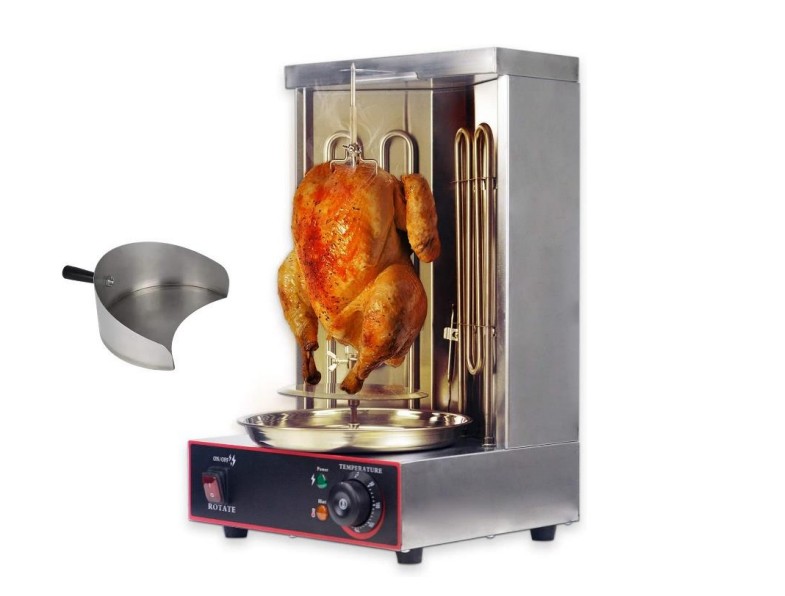
Vertical Broiler Cooking and Handling Instructions
A compliant vertical broiler is ANSI approved and designed to cook meat on a vertical rotisserie spit. The meats to be cooked on these units are shaped in the form of a cone and are either frozen compacted ground (beef, chicken, or lamb. The meat cone is inserted into the rotating vertical spit which allows the meat to be cooked and sliced off during the cooking process. This broiler only cooks the external meat surfaces, which means the internal layers of the cone remain raw. There are important food safety considerations when cooking with this type of equipment to prevent bacterial growth and foodborne illness.
During Cooking:
- Recommend limiting the size of the cone to ten (10) pounds or less.
- The cooking process must occur continually without any interruptions.
- The cooking may be interrupted only to allow for safety during the carving action. Under no circumstances shall the broiling unit be turned off and on during the course of the day to compensate for slow sales periods. All meat shall be fully cooked within a maximum use time of four (4) hours.
- Separate utensils must be used for proper handling of the undercooked (raw) and cooked meat.
End of Cooking:
- Meat must be fully cooked to 155°F (or 165°F chicken) for 15 seconds prior to serving unless the menu has a compliant consumer advisory disclosure.
- To adequately monitor cooking temperatures throughout the cooking period, a fast-response thermocouple thermometer that can easily penetrate the meat cone up to a depth of two (2) inches is required. The rapid response of these units allows accurate readings to be made at varying depths into the cone of meat. A slow response thermometer is entirely inadequate for this use since measurements must be taken as the cone is cooking and rotating.
- Quick and frequent measurements are necessary to effectively monitor the depth of adequate cooking temperature into the cone. This thermocouple is also used for monitoring cooling and holding temperatures, where appropriate.
- Sliced meats shall be held in a steam table or other hot holding equipment to maintain internal food temperatures at least 135°F. Sliced meats can be saved for later use if it is fully cooked before rapidly cooling to 70°F within two (2) hours and then to 41°F within the next four (4) hours. Refer to the supplemental Cooling Log form for guidance.
- Any remaining partially cooked meat cone or undercooked slices of meat that did not reach 155°F cannot be cooled for later use.
If remaining thawed meat on the cone is not fully cooked to 155°F (or 165°F for chicken) at the end of four hours, then the portions that are above 41°F must be discarded. After thawed surfaces are shaved off, only the remaining meat measuring 41°F or below may be placed back in the freezer for later use.
Reheating:
Any properly cooled meats must be rapidly reheated to 165°F within two (2) hours. After proper reheating, the meats shall be immediately served or hot held at 135°F or above in approved hot holding equipment.
Routine Cleaning and Maintenance:
- All components and attachments of the vertical broiler including skewer, catch pan, drip pan, meat base, and heat shield must be washed, rinsed, and sanitized after each use. Any knives or utensils used shall be washed, rinsed, and sanitized at least every four (4) hours.
- Knives, carved meat catch pans, and thermometers must be cleaned and sanitized before use and after cuts are made that are deep enough to penetrate or slice into undercooked regions of the meat or poultry cone.
- When the vertical broiler is moved for cleaning, ensure it is returned and positioned at a minimum of six (6) inches within the ventilation hood.
General Guidance:
- Proper rotation practices must be followed. No co-mingling of leftover and freshly prepared or carved meat or poultry is permitted.
- The meat cone must be from a USDA inspected meat plant, where it is quick frozen. The meat cone can be prepared by a retail food facility if it is cooked and served at the same retail food facility.
Contact your district health inspector if you have any questions concerning implementing these standard operating procedures